
With the rise in requests for service in regards to people riding electric motorcycles in the roadways of Skamania county, The Skamania County Sheriff’s Office wants all riders to be safe and know the difference between electric motorcycles and electric-assisted bicycles.
The Revised Code of Washington (RCW) states the differences between a bicycle, electric-assisted bicycle and motorcycle in Title 46 Chapter 46.04.
The following are the RCW’s that define the differences:
RCW 46.06.071 “Bicycle” means every device propelled solely by human power, or an electric-assisted bicycle as defined in RCW 46.04.169, upon which a person or persons may ride, having two tandem wheels either of which is sixteen inches or more in diameter, or three wheels, any one of which is twenty inches or more in diameter.
46.04.169 “Electric-assisted bicycle” means a bicycle with two or three wheels, a saddle, fully operative pedals for human propulsion, and an electric motor. The electric-assisted bicycle’s electric motor must have a power output of no more than seven hundred fifty watts. The electric[1]assisted bicycle must meet the requirements of one of the following three classifications: (1a) “Class 1 electric-assisted bicycle” means an electric-assisted bicycle in which the motor provides assistance only when the rider is pedaling and ceases to provide assistance when the bicycle reaches the speed of twenty miles per hour; (1b) “Class 2 electric-assisted bicycle” means an electric-assisted bicycle in which the motor may be used exclusively to propel the bicycle and is not capable of providing assistance when the bicycle reaches the speed of twenty miles per hour; or (1c) “Class 3 electric-assisted bicycle” means an electric-assisted bicycle in which the motor provides assistance only when the rider is pedaling and ceases to provide assistance when the bicycle reaches the speed of twenty-eight miles per hour and is equipped with a speedometer.
(2) “Electric-assisted bicycle” does not include: (2a) Any vehicle capable of exceeding 20 miles per hour on solely its electric motor; or (2b) Any vehicle that is designed, manufactured, or intended by the manufacturer or seller to be easily configured in order not to meet the requirements of an electric-assisted bicycle, whether by a mechanical switch or button, by changing a setting in software controlling the drive system, by use of an online application, or through other means intended by the manufacturer or seller.
46.04.330 “Motorcycle” means a motor vehicle designed to travel on not more than three wheels, not including any stabilizing conversion kits, on which the driver: (1) Rides on a seat or saddle and the motor vehicle is designed to be steered with a handlebar; or (2) Rides on a seat in a partially or completely enclosed seating area that is equipped with safety belts and the motor vehicle is designed to be steered with a steering wheel. “Motorcycle” excludes a farm tractor, a power wheelchair, an electric personal assistive mobility device, a motorized foot scooter, an electric-assisted bicycle, and a moped.
Washington state law (RCW) defines the difference between these, as well as the three classes for electric-assisted bicycles. Electric assisted bicycles have a maximum speed of 20mph when the pedals are not in use, or a maximum speed of 28mph with the use of the pedals. A motorcycle is only powered by the motor, regardless of it being electric or fuel and does not have pedals.
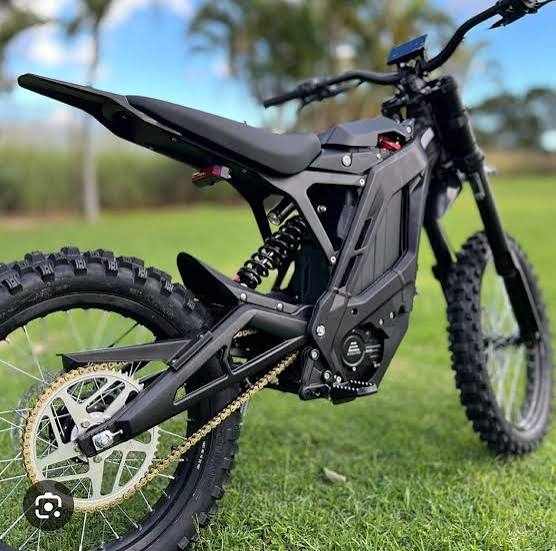
The image of the electric motorcycle show a vehicle that is not legal to ride on any street and/or sidewalk in Washington State. The electric motorcycle does not have many of the required safety features to make it road legal. You must have a state permit (eligibility starts at age 16), or endorsement (must be 18 or older) to ride motorcycles in Washington State.